

How you can go about choosing correct pumps
1. Measure or note:
- Depth to water source (if borewell) or from suction point
- Height to rooftop tank or highest outlet
- How many floors (this affects head required)
- Number of taps / showers / appliances that might run at once
- Electricity supply type (single phase / three phase) and voltage stability
- Type of water (clean / has silt / dirty / waste etc.)
- Decide on required flow: say you want 2 bathrooms + kitchen + washing machine running together – what flow rate is needed? Convert to litres/min.
- Add safety margin (head & flow) so pump isn’t always working at its max.
- Pick pump type that suits source + demand.
- Compare models: check power rating, head, flow curves, material, protection features, warranty.
- Consider installation: does pump require special mounting, priming, or special kind of pipe etc.
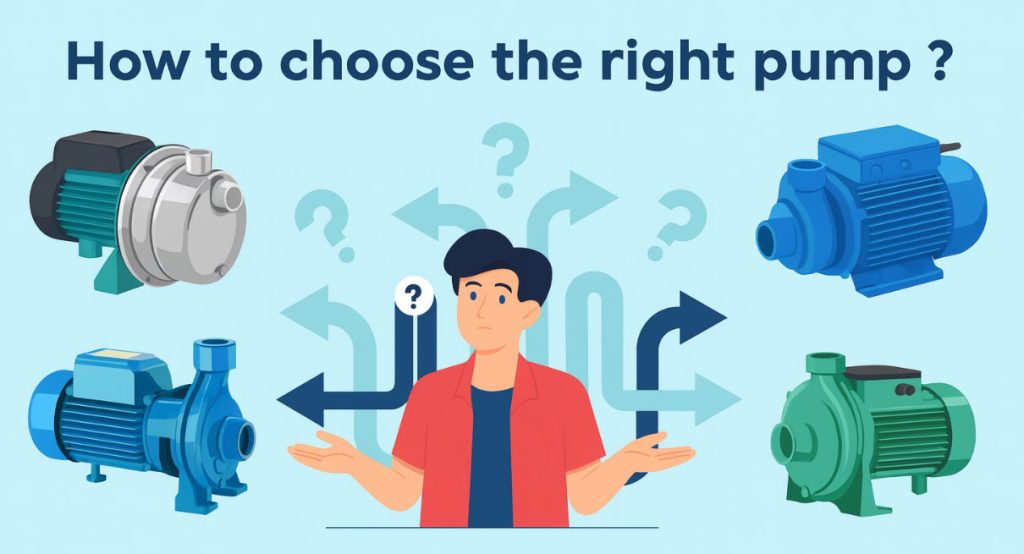
Choosing the right pump for your needs
Depends on understanding where and how it will be used. For homes and apartments, compact domestic pumps like centrifugal or submersible models are perfect for supplying water to bathrooms, kitchens, and small gardens, offering ease of use and low maintenance. Farmers and agricultural users often rely on submersible or solar pumps, which deliver reliable irrigation while saving energy and costs in the long run. On the other hand, industries demand heavy-duty pumps made from robust, corrosion-resistant materials that can handle high flow rates, extreme pressures, and even abrasive or chemical fluids, making them ideal for continuous, large-scale operations. Key factors to consider before purchasing include flow rate (how much water needs to be moved), pressure or head (the distance or height the water must be pumped), and the available power source, whether electric, solar, or diesel. While domestic pumps are affordable and user-friendly, industrial pumps are long-term investments built for efficiency and durability. By carefully assessing your purpose, water demand, and budget, you can select a pump that ensures reliable performance, energy efficiency, and lasting value for years to come.
The “right pump” depends entirely on where and how you plan to use it. For homes, compact and efficient domestic pumps do the job. For farms, solar or submersible pumps ensure reliable irrigation. And for industries, robust pumps built for continuous operation are the best choice. By considering your purpose, flow requirements, power source, and budget, you can invest in a pump that provides reliable performance for years to come.
Blog 1
February 8, 2023